Honeycomb pleated blind – privacy, aesthetics, improved indoor climate and acoustics
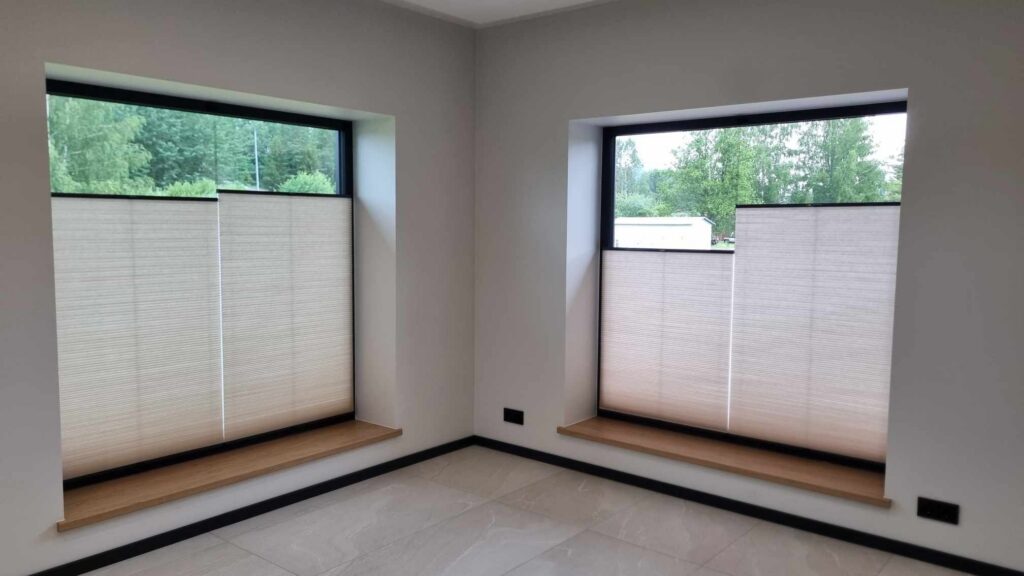
A honeycomb pleated blind or a double-layered pleated blind might be a confusing solution without previous experience. In RULO’s everyday work, we see that customers ordering window coverings often struggle to tell the difference between roller blinds and pleated blinds—let alone the differences between single-layer pleated blinds and honeycomb (cellular) pleated blinds. The purpose of this blog post is to give a clear overview of the features of honeycomb pleated blinds and how they differ from classic pleated blinds.
What is a honeycomb pleated blind?
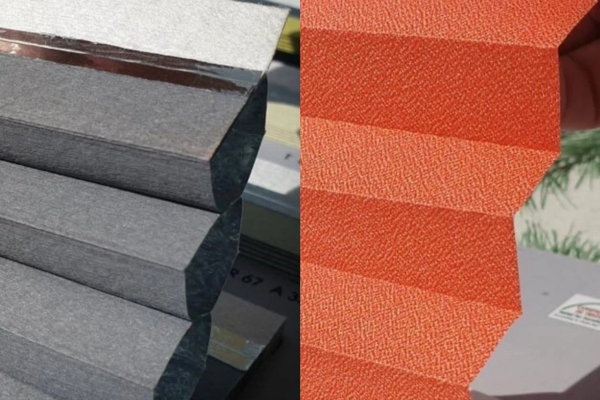
A standard pleated blind consists of a single pleated (regularly folded) layer of fabric. A honeycomb pleated blind, however, is made up of two interconnected pleated fabric layers which, as the name suggests, form a honeycomb-like structure.
This solution was developed in the Netherlands in the late 1980s with clearly practical goals: to improve thermal insulation, reduce heat loss in winter, and keep living and working spaces cooler in summer. This is where the honeycomb structure of the double-layered pleated blind comes into play. The air pockets trapped between the fabric layers are poor conductors of heat and restrict air movement (convection). In addition to thermal insulation, the cellular structure and the air trapped between the layers also act as a sound insulator, improving room acoustics.
As an aesthetic bonus, the cords required to raise and lower the blind (and the holes in each pleat) are hidden neatly between the two fabric layers.
What does the claim that honeycomb pleated blinds reduce heat loss by nearly 40% actually mean?
It makes sense to start with what this definitely does not mean: honeycomb pleated blinds do not reduce your home’s or office’s heating costs by 40%. There is a clear impact on heating costs, but depending on the rooms and window sizes, the savings compared to uncovered windows typically remain around 10%. In other words, the 40% figure refers to heat loss through the window.
Heat loss (Q, measured in watts) is calculated using the formula Q = U × A × ΔT, where thermal transmittance (U, W/m²K), window area (A, m²), and the temperature difference between indoor and outdoor air (ΔT, K) are multiplied together. In Estonia, where the temperature difference between indoors and outdoors in winter can reach 40–50 degrees, windows and their thermal performance play a major role in heating costs.

When honeycomb pleated blinds are installed on a window, thermal insulation improves and, as a result, thermal transmittance (U) decreases. According to both the formula and common sense, this directly reduces heat loss. So the widely advertised 40% reduction in heat loss essentially refers to a comparison between the thermal transmittance of a bare window and that of a window covered with a honeycomb pleated blind. The more windows you have—and the larger they are—the greater the benefit.
How much does a double-layered pleated blind improve room acoustics?
Although a honeycomb pleated blind is not a soundproof solution, its multi-layered structure helps soften room acoustics. The result is not dramatic, but it is noticeable in everyday use. The effect of double-fabric pleated blinds on acoustics works in two ways:
1) A honeycomb pleated blind reduces echo inside the room
Bare glass is a hard, reflective surface that causes sound to bounce back into the room, creating echo. A honeycomb blind (or any curtain) adds a soft surface and an air gap in front of the glass, which partially absorbs sound.
2) A honeycomb pleated blind reduces external noise
The blind adds an additional “layer” in front of the window and creates an air gap that can reduce sound transmission at certain frequencies. However, the window itself is often the weak point (glass + frame + gaps). Therefore, honeycomb blinds usually provide a small to moderate improvement against external noise. Significantly better results come from a higher-quality insulated glazing unit.
Plus all the advantages of a “regular” pleated blind
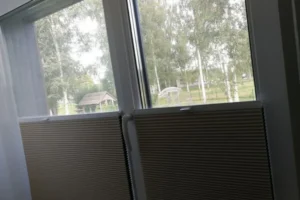
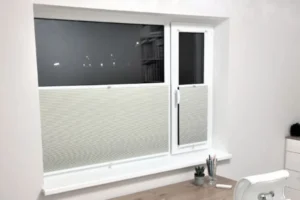
Like all pleated blinds, honeycomb pleated blinds provide privacy and allow you to cover different parts of the window from both the top and the bottom. This means, for example, that on a ground floor you can enjoy privacy and natural daylight at the same time. The blind moves together with the window sash, so even when the window is tilted open, it still offers protection from direct sunlight and prying eyes.
RULO offers both semi-blackout and blackout honeycomb pleated blinds
In terms of both functionality and aesthetics, honeycomb pleated blinds are one of the best window covering solutions in RULO’s product range. Put together your order conveniently in our online store: